
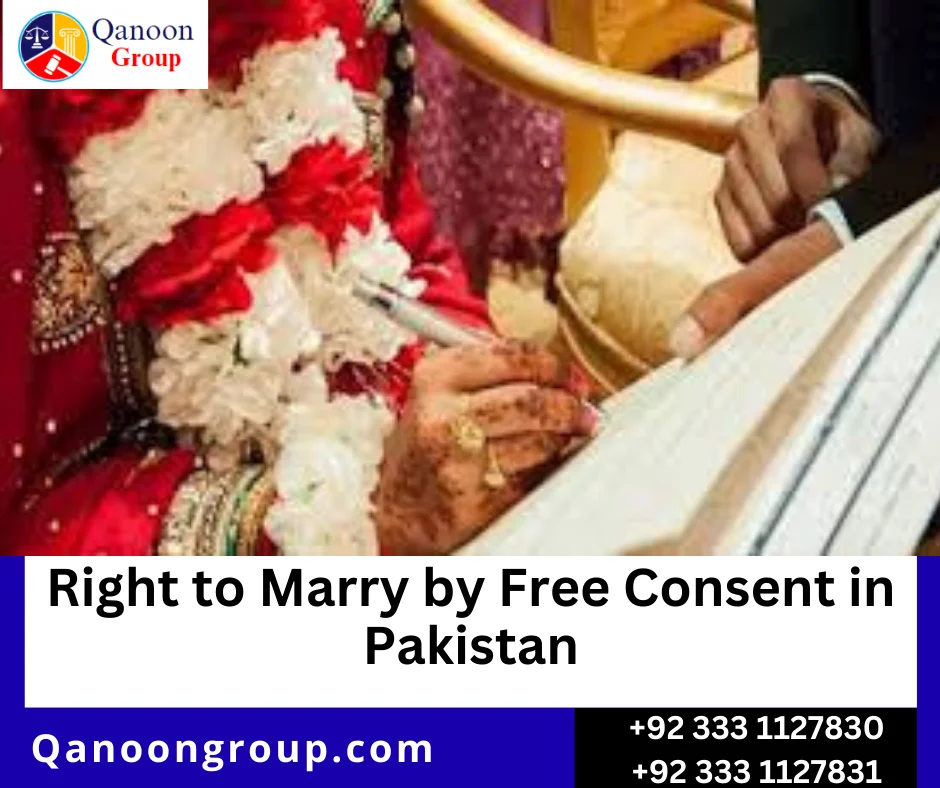
Right to Marry by Free Consent in Pakistan
Free consent is the legal and constitutional foundation of marriage in Pakistan. A marriage performed without free consent is not merely irregular or defective; it strikes at the very root of legality, personal liberty, and human dignity. Pakistani law, constitutional jurisprudence, and Islamic principles converge on one central rule: no individual may be compelled into marriage against their will.
This principle is not symbolic. It is enforceable, litigated, and repeatedly affirmed by Pakistani courts across decades.
Understanding Free Consent in Marriage
Adult free consent under Pakistani family law is a voluntary, informed, and independent agreement to enter into marriage, given by a person who is legally competent and mentally sound, without coercion, pressure, threat, deception, or undue influence.
In the context of Pakistani law, free consent is assessed not by ritual formalities, but by the actual will of the parties at the time of marriage. Any marriage lacking genuine consent is vulnerable to legal challenge, annulment, or criminal consequences.
Marriage, therefore, is not a family decision, a social arrangement, or a cultural obligation. It is a personal legal act.
Constitutional Protection of the Right to Marry
The Constitution of Pakistan guarantees personal liberty, dignity, and freedom of choice. Courts have consistently interpreted these protections to include the right of an adult to marry by free consent.
Pakistani jurisprudence treats marriage as an extension of:
- personal autonomy
- freedom of association
- privacy and dignity
Any attempt to interfere with an adult’s marital choice is viewed as a violation of constitutional rights, regardless of social, tribal, or familial objections.
Free Consent Under Islamic Law
Islamic jurisprudence places extraordinary emphasis on consent in marriage. A Nikah performed without the willing consent of the bride or groom is religiously defective.
Key Islamic principles include:
- Consent must be explicit and voluntary
- Silence under pressure does not constitute consent
- Coercion invalidates the moral legitimacy of Nikah
Pakistani courts routinely align legal interpretation with these Islamic principles, reinforcing that forced marriages are neither legally nor religiously valid.
Legal Framework Governing Consent in Pakistan
Pakistani statutory law does not treat consent as a technical formality. It is a substantive requirement.
Courts examine:
- statements of the parties
- surrounding circumstances
- family pressure or threats
- conduct before and after marriage
If consent is found to be compromised, the marriage may be declared voidable, irregular, or unlawful depending on facts.


Forced Marriage and Its Legal Consequences
A forced marriage is one in which free consent is absent due to:
- physical force
- emotional coercion
- threats of harm
- social or economic pressure
- misrepresentation or fraud
Such marriages expose perpetrators to:
- criminal liability
- civil litigation
- constitutional petitions
- habeas corpus proceedings
Pakistani courts have repeatedly held parents, relatives, and community actors accountable where coercion is proven.
Adult Marriages Against Family Will
One of the most litigated areas in Pakistan concerns adults marrying without family approval. The legal position is settled:
An adult has an absolute right to marry by free consent.
Family disapproval does not:
- invalidate marriage
- justify confinement
- permit harassment
- allow criminal cases against spouses
Courts routinely grant protection to couples where threats or false cases are used to undermine their free consent.
Role of Nikah Khawan and Witnesses
The presence of a Nikah Khawan or witnesses does not automatically prove free consent. Courts look beyond documents to determine whether consent was genuine.
A Nikah Khawan has a moral and legal responsibility to:
- ascertain voluntary consent
- refuse solemnization if coercion is apparent
- ensure clarity of acceptance
Failure to do so may raise serious legal questions in later proceedings.
Women’s Right to Free Consent
Pakistani law explicitly recognizes a woman’s independent legal personality in marriage matters. A woman does not require:
- parental permission
- guardian approval
- family consent
Any marriage imposed on a woman without her free consent is legally vulnerable and religiously questionable. Courts treat such cases with heightened scrutiny.
Free Consent and Court Marriage
Court marriage procedures in Pakistan are designed primarily to protect free consent. Affidavits, personal appearances, and verification steps exist to ensure that the decision to marry is voluntary.
Courts are especially cautious in:
- interfaith marriages
- family-opposed marriages
- protection petitions
The entire framework revolves around safeguarding free consent.
Criminal Misuse Against Consenting Couples
It is common for families to file false criminal cases to undo marriages contracted by free consent. Pakistani courts have strongly condemned this practice.
Judicial precedents establish that:
- criminal law cannot be weaponized to punish lawful marriage
- adult consent overrides social objections
- liberty of spouses must be protected
This judicial stance has significantly strengthened the right to marry freely.

Free Consent and Mental Capacity
Free consent requires mental soundness. Courts examine:
- understanding of marriage consequences
- coherence of statements
- absence of psychological manipulation
Mental incapacity or deception at the time of consent may invalidate the marriage.
International Human Rights Perspective
Pakistan’s obligations under international human rights instruments reinforce the right to marry by free consent. Forced marriage is internationally recognized as a human rights violation.
Domestic courts increasingly reference international norms while deciding consent-related cases.
Legal Remedies Where Consent Is Violated
Where free consent is compromised, affected persons may seek:
- annulment or declaration of invalidity
- criminal prosecution
- constitutional relief
- protective orders
Timely legal action is critical in such cases.
Social Customs vs Legal Rights
Cultural practices, tribal customs, or family expectations have no legal authority when they conflict with free consent. Courts consistently prioritize law and constitution over social norms.
This judicial clarity has reshaped marriage jurisprudence in Pakistan.
Importance of Documentation and Evidence
Written records, affidavits, medical reports, and consistent conduct help establish free consent. Courts assess evidence holistically, not mechanically.
The Evolving Jurisprudence on Free Consent
Over time, Pakistani courts have expanded the interpretation of free consent, strengthening protections against forced marriage and unlawful interference.
The trend is firmly rights-oriented and constitutionally grounded.
Judicial Interpretation of Free Consent in Pakistan
Pakistani courts have repeatedly clarified that free consent is the decisive factor in determining the validity of a marriage. Judicial scrutiny does not stop at Nikah Nama execution or ceremonial compliance; instead, courts focus on whether consent was real, voluntary, and independent at the time of marriage.
Over time, superior courts have developed a consistent line of reasoning that treats marriage as a matter of personal liberty rather than family authority.
Superior Courts on Adult Right to Marry by Free Consent
The superior judiciary has firmly held that an adult’s decision to marry by free consent falls within the sphere of constitutional protection. Courts have declared that once a person attains majority, their marital choice becomes a private legal decision, immune from parental or societal veto.
In multiple judgments, High Courts have emphasized that:
- adulthood confers decisional autonomy
- consent overrides family opposition
- personal liberty cannot be curtailed through custom
This reasoning has become settled law.
Free Consent vs Family Pressure — Judicial Test
Courts apply a substance-over-form test when assessing consent. Even where a Nikah Nama exists, courts examine whether the surrounding circumstances reveal pressure, intimidation, or fear.
Indicators courts look for include:
- sudden disappearance or confinement before marriage
- contradictory statements under family presence
- immediate post-marriage hostility or threats
- filing of criminal cases after marriage
Where such indicators exist, courts do not hesitate to intervene.
Habeas Corpus Petitions and Free Consent
Habeas corpus petitions are frequently filed in cases where adults marry by free consent and are subsequently confined by family members. Pakistani courts have consistently ruled that illegal confinement in the name of family honor or tradition is unlawful, regardless of marital approval.
In such cases, courts:
- order immediate recovery of the confined person
- record statements in camera
- prioritize the individual’s expressed free will
These cases have significantly strengthened enforcement of free consent.
Criminal Cases Filed to Undermine Consent
One recurring pattern observed by courts is the misuse of criminal law to invalidate marriages performed by free consent. FIRs alleging abduction, zina, or fraud are often lodged after the marriage has taken place.
Judicial response has been clear:
- criminal law cannot nullify lawful marriage
- consent of an adult negates kidnapping allegations
- mala fide prosecutions are liable to be quashed
This stance has discouraged abuse of the criminal process.
Women-Centric Jurisprudence on Consent
Pakistani courts have shown heightened sensitivity in cases involving women’s free consent. Judicial observations repeatedly affirm that a woman’s consent is not subordinate to family wishes.
Courts have rejected arguments that:
- cultural norms override consent
- silence implies acceptance
- family honor justifies coercion
Instead, women’s autonomous consent is treated as legally decisive.
Free Consent and Protection Orders
Where credible threats exist against couples who marry by free consent, courts grant protection orders. These orders serve both preventive and declaratory functions, reinforcing that lawful marriage cannot be punished through violence or intimidation.
Such orders are often accompanied by:
- police protection
- restraining directions to relatives
- warnings against harassment
Interfaith and Inter-Sect Marriages
In sensitive marriages involving interfaith or inter-sect elements, courts apply even stricter scrutiny to ensure free consent. Judicial emphasis remains on voluntariness, understanding, and absence of inducement or coercion.
Courts distinguish clearly between:
- voluntary conversion and forced conversion
- informed consent and manipulated consent
This nuanced approach protects both religious freedom and personal liberty.


Evidentiary Value of Statements in Court
Statements recorded before a magistrate or judge carry significant evidentiary value in establishing free consent. Courts often rely on:
- consistency of statements
- demeanor and coherence
- absence of contradiction
Once free consent is judicially recorded, later allegations are viewed with skepticism.
Evolution from Patriarchy to Autonomy
Earlier social attitudes treated marriage as a family-controlled institution. Modern Pakistani jurisprudence reflects a decisive shift toward individual autonomy, aligning constitutional values with contemporary realities.
This evolution has reshaped:
- family law litigation
- criminal justice responses
- protection jurisprudence
Free consent now sits at the center of marriage legality.
Practical Guidance for Protecting Free Consent
From a legal-risk perspective, couples should:
- document consent clearly
- record statements before authorities where needed
- avoid secrecy that invites allegations
- seek timely legal guidance
These steps strengthen the evidentiary foundation of free consent.
Strategic Importance for Legal Practitioners
For lawyers, free consent cases require:
- careful factual assessment
- constitutional framing
- early protective relief
- control of narrative against criminal misuse
Handled correctly, courts respond decisively in favor of liberty.
Judicial Precedents on Free Consent in Marriage
Pakistani High Courts have repeatedly affirmed that free consent of an adult is the cornerstone of a valid marriage, and that neither family opposition nor social custom can override this right.
Lahore High Court — Adult Right to Marry by Choice
The Lahore High Court has consistently held that an adult Muslim woman is competent to contract marriage of her own free will. In multiple judgments, the Court clarified that parental consent is not a legal requirement where the individual has attained majority and possesses sound mind.
The Court further observed that confinement or harassment of an adult woman for exercising her marital choice constitutes a violation of fundamental rights.
Islamabad High Court — Personal Liberty and Marital Autonomy
The Islamabad High Court has emphasized that the right to marry by free consent flows directly from constitutional guarantees of liberty and dignity. The Court has rejected the notion that family honor or societal expectations can justify interference in an adult’s decision to marry.
In several cases, the Court ordered protection for couples who married by choice and restrained relatives from intimidation or misuse of criminal law.
Sindh High Court — Consent Overrides Allegations of Abduction
The Sindh High Court has repeatedly ruled that where an adult woman voluntarily contracts marriage, allegations of abduction or unlawful confinement lose legal force. The Court has quashed criminal proceedings where evidence demonstrated free consent and lawful marriage.
The Court has further observed that criminal law cannot be used as a tool to undo marriages solemnized with free consent.
Peshawar High Court — Forced Marriage Has No Legal Sanctity
The Peshawar High Court has taken a firm stance against forced marriages, declaring that any marriage contracted under coercion lacks legal sanctity. The Court has underscored that consent obtained through pressure, threats, or deception cannot be treated as valid consent.
The Court has also acknowledged that cultural practices cannot supersede constitutional protections.
High Courts on Habeas Corpus and Free Will
Across jurisdictions, High Courts have consistently used habeas corpus jurisdiction to recover adults unlawfully confined after contracting marriage by free consent. Courts record statements independently to ascertain voluntariness and, once satisfied, order immediate release and protection.
Such jurisprudence has played a crucial role in enforcing the practical meaning of free consent.
Comparative Case-Law Table on Free Consent in Marriage (Pakistan)
Court | Judicial Principle Affirmed | Legal Takeaway |
Lahore High Court | An adult Muslim woman is legally competent to contract marriage of her own free consent without parental approval. | Family consent is not a legal requirement once majority and mental soundness are established. |
Islamabad High Court | The right to marry by free consent flows directly from constitutional guarantees of liberty and dignity. | Marital choice of an adult is a protected fundamental right, immune from social or familial interference. |
Sindh High Court | Voluntary marriage by an adult negates allegations of abduction or unlawful confinement. | Criminal proceedings cannot be used to invalidate marriages based on free consent. |
Peshawar High Court | Consent obtained through coercion, pressure, or threats is not valid consent. | Forced marriages lack legal sanctity and are vulnerable to judicial invalidation. |
Sindh High Court | FIRs lodged after marriage to exert pressure are indicative of mala fide intent. | Criminal law cannot be weaponized to undo lawful marriages. |
Lahore High Court | Illegal confinement of an adult woman for opposing family wishes violates constitutional rights. | Habeas corpus jurisdiction may be invoked to protect free consent. |
Islamabad High Court | Honor-based objections have no legal recognition where free consent exists. | Cultural norms cannot override constitutional protections. |
All High Courts (Consistent View) | Statements recorded before courts carry decisive evidentiary value regarding consent. | Judicially recorded consent outweighs later allegations or retractions. |
All High Courts (Habeas Corpus Jurisprudence) | Adults unlawfully confined after marrying by choice must be recovered and protected. | Courts actively enforce free consent through recovery and protection orders. |
The Settled Legal Position on Free Consent in Pakistan
Pakistani law no longer treats marriage as a collective or family-controlled institution. Through constitutional interpretation, statutory application, and consistent judicial reasoning, free consent has emerged as the decisive legal test for the validity of marriage.
Courts have repeatedly clarified that adulthood brings with it decisional autonomy. Once a person is legally competent, their choice to marry becomes a matter of personal liberty, protected against interference by family members, social customs, or community pressure.
This legal position is not theoretical. It is actively enforced through constitutional petitions, habeas corpus proceedings, protection orders, and criminal law safeguards. Where consent is proven to be free and voluntary, courts have shown zero tolerance for harassment, confinement, or misuse of legal process.
The right to marry by free consent in Pakistan now stands on firm ground — constitutionally protected, religiously aligned, and judicially settled.
FAQs – Right to Marry by Free Consent in Pakistan
What is meant by free consent in marriage?
Free consent means voluntary and independent agreement to marry, without pressure, coercion, or deception.
Is parental approval required for marriage in Pakistan?
No. An adult may marry by free consent without parental approval.
Can a forced marriage be challenged in court?
Yes. Forced marriages are legally challengeable and may result in annulment or criminal liability.
Is free consent required under Islamic law?
Yes. Consent is a fundamental requirement of Nikah in Islam.
Can family opposition invalidate a marriage?
No. Family opposition has no legal effect if free consent exists.
Does court marriage ensure free consent?
Court procedures are designed to protect free consent but courts still examine facts independently.
Can witnesses be relatives?
Yes. Witnesses may be relatives; independence is not legally required.
What remedies exist if consent was coerced?
Legal remedies include annulment, criminal action, and constitutional petitions.
Can courts override family objections to marriage?
Yes. Courts consistently prioritize free consent over family objections.
Does a Nikah Nama alone prove consent?
No. Courts examine surrounding circumstances to assess genuine consent.
Can police stop an adult marriage?
No. Police have no authority to interfere with marriages based on free consent.
Are honor-based objections legally valid?
No. Courts reject honor-based interference with marital liberty.
Can protection be sought before marriage?
Yes. Courts may grant pre-emptive protection where threats exist.