
Extract of Muslim Family Laws Ordinance 1961 (Pakistan)
The Muslim Family Laws Ordinance 1961 is the principal statutory framework governing Muslim marriage, divorce, maintenance, polygamy regulation, and Nikah registration in Pakistan. It applies to all Muslim citizens of Pakistan and overrides any contrary custom or usage in matters of Muslim family law.
This Ordinance establishes the legal structure for marriage registration, Union Council oversight, Arbitration Councils, and procedural safeguards for spouses, particularly in matters of talaq, maintenance, and multiple marriages.
Short Title, Extent, and Application
The law is formally titled the Muslim Family Laws Ordinance 1961 and extends to the whole of Pakistan. It applies to all Muslim citizens wherever they reside and operates as the governing statute for Muslim family matters under Pakistani law.
Muslim-Family-Laws-Ordinance-19…
Definitions and Key Authorities under the Ordinance
The Ordinance defines several institutional authorities essential to marriage regulation:
- Arbitration Council — a body formed to decide disputes or permissions under the Ordinance
- Chairman — typically the Union Council Chairman or authorized local authority
- Union Council — the civil authority responsible for marriage registration and records
- Nikah Registrar — licensed official authorized to register Muslim marriages
These authorities collectively administer marriage registration, reconciliation, maintenance, and polygamy permissions under Pakistani law.
Muslim-Family-Laws-Ordinance-19…
Legal Supremacy of the Ordinance
The Ordinance expressly overrides any contrary custom, usage, or law in matters of Muslim marriage and registration. All Muslim marriages must be registered strictly according to its provisions.
Court procedural laws and arbitration statutes do not apply to Arbitration Councils constituted under this Ordinance.
Muslim-Family-Laws-Ordinance-19…
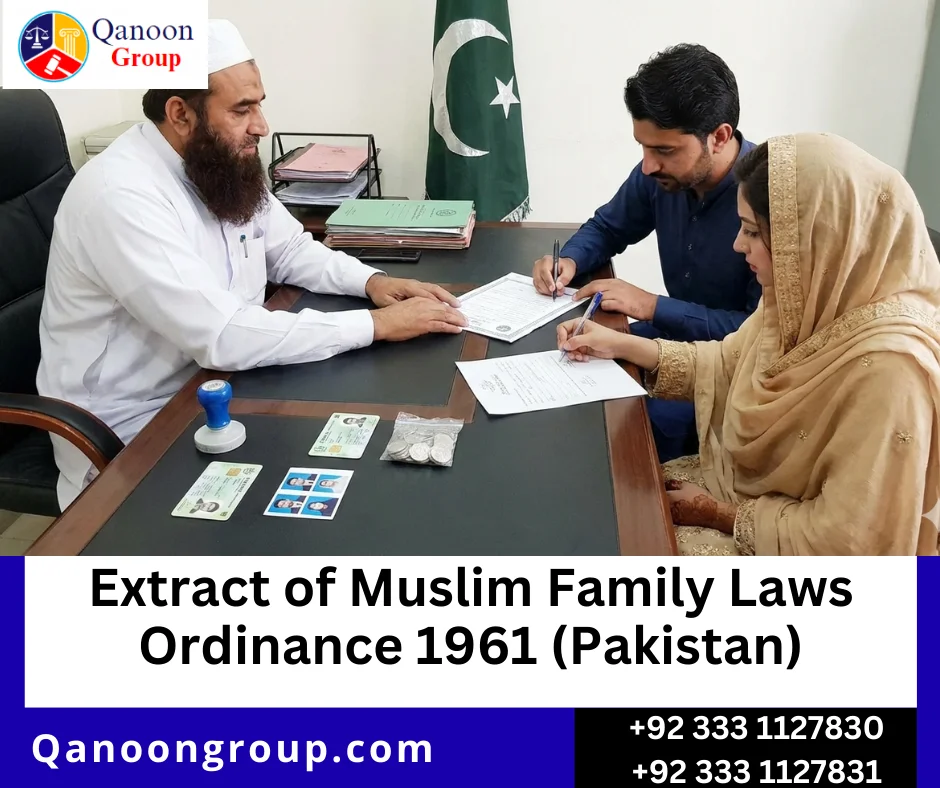
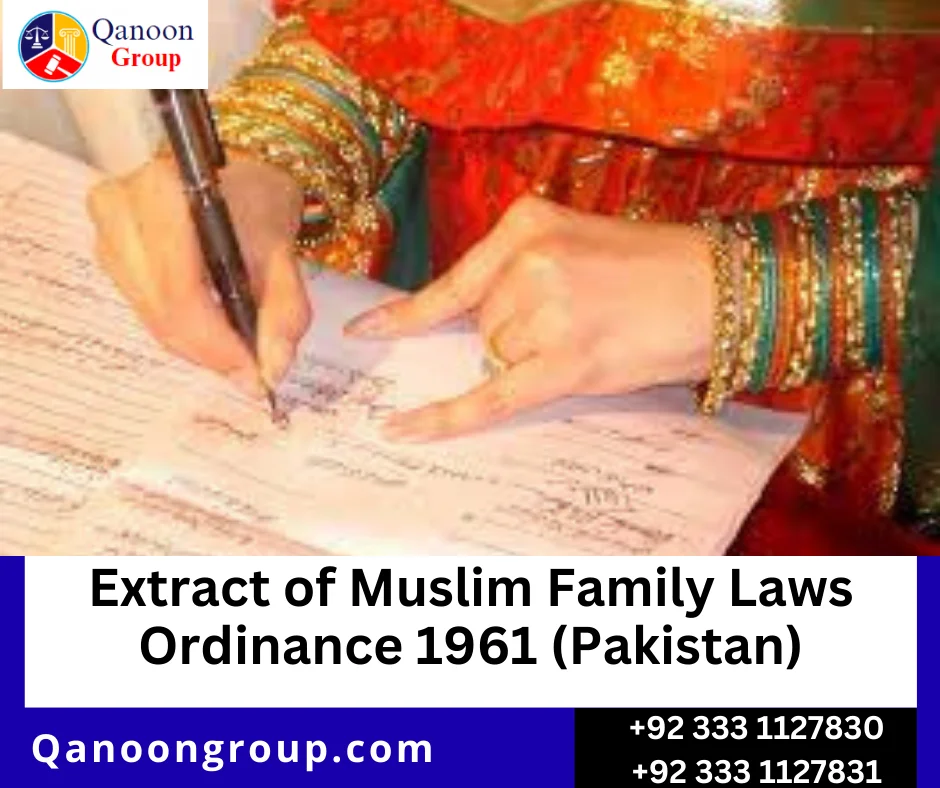
Registration of Muslim Marriage (Nikah)
Every Muslim marriage solemnized in Pakistan must be registered with the Union Council through a licensed Nikah Registrar.
Key statutory requirements include:
- Union Council licenses Nikah Registrars for each ward
- Marriage solemnized by others must be reported to the Registrar
- Failure to report is punishable
- Prescribed Nikahnama forms and registers must be maintained
- Parties may inspect or obtain Nikahnama records
This establishes the legal foundation of Nikah registration and civil marriage documentation in Pakistan.
Muslim-Family-Laws-Ordinance-19…
Polygamy Regulation and Permission
A Muslim man cannot contract another marriage during an existing marriage without prior written permission of the Arbitration Council.
Procedure:
- Application submitted to Union Council Chairman
- Existing wife/wives notified and represented
- Council evaluates necessity and justice
- Decision recorded with reasons
- Revision allowed before Collector
Consequences of unauthorized second marriage:
- Immediate payment of full dower to existing wife/wives
- Possible imprisonment up to one year or fine
Unapproved marriages cannot be registered under the Ordinance.
Muslim-Family-Laws-Ordinance-19…
Talaq Procedure and Legal Effect
A husband pronouncing talaq must:
- Notify the Union Council Chairman in writing
- Provide copy to wife
Legal effect:
- Talaq becomes effective after 90 days from notice
- Arbitration Council must attempt reconciliation
- If wife is pregnant, talaq effective after pregnancy ends
- Remarriage between same spouses allowed unless third talaq
Failure to notify is punishable with imprisonment or fine.
This section establishes Pakistan’s statutory talaq notification and reconciliation system.
Muslim-Family-Laws-Ordinance-19…
Dissolution of Marriage Otherwise than Talaq
Where divorce rights are delegated to the wife or dissolution is sought otherwise than talaq, the same procedural rules of Section 7 apply mutatis mutandis.
This covers delegated divorce (talaq-e-tafweez) and other dissolution mechanisms under Muslim family law.
Muslim-Family-Laws-Ordinance-19…
Maintenance of Wife
If a husband fails to maintain his wife or wives adequately:
- Wife may apply to Union Council Chairman
- Arbitration Council determines maintenance amount
- Certificate issued specifying payable amount
- Recoverable as arrears of land revenue
Revision lies before the Collector whose decision is final.
This establishes statutory maintenance enforcement under Pakistani Muslim family law.
Muslim-Family-Laws-Ordinance-19…
Dower (Haq Mehr)
If the Nikahnama does not specify payment mode of dower:
- Entire dower is presumed payable on demand
This provision protects the wife’s financial right where Nikahnama is silent.
Muslim-Family-Laws-Ordinance-19…
Succession Representation of Pre-deceased Children
If a son or daughter dies before inheritance opens, their children inherit the share that the deceased parent would have received.
This provision introduces representation in Muslim inheritance under Pakistani statutory law.
Muslim-Family-Laws-Ordinance-19…
Rule-Making Powers
Federal or Provincial Governments may make rules to implement the Ordinance, including:
- Nikahnama forms
- Registration procedures
- Registrar records
- Fees and documentation
Rules published in the official Gazette have legal force equivalent to the Ordinance.
Muslim-Family-Laws-Ordinance-19…
Legal Significance of the Muslim Family Laws Ordinance 1961
The Ordinance forms the statutory backbone of Muslim family regulation in Pakistan by:
- Mandating Nikah registration
- Regulating polygamy
- Standardizing talaq procedure
- Enforcing maintenance rights
- Protecting dower claims
- Establishing Arbitration Councils
All Union Council marriage registration systems, Nikah Registrar licensing, and NADRA-linked marriage documentation frameworks ultimately derive authority from this Ordinance.